
Kumulus Distributed File System (DFS)
Scale-Out Parallel Storage for AI, HPC, and GPU Workloads
Value proposition
Parallel I/O scales linearly with node count — no performance ceiling as compute and data grow.
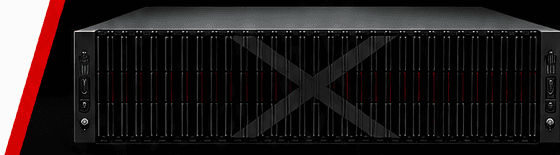
A high-performance, linearly scalable distributed file system engineered to eliminate storage bottlenecks in the most demanding compute environments. Built on a global namespace architecture (GX-IO), it delivers consistent high throughput as you scale — from tens to thousands of nodes — with optional integrated archiving via ARC for complete lifecycle management.
Key benefits
Massive Scale-Out
Scale to billions of files and petabytes of data with linear growth.
High Performance
Optimized metadata handling for high IOPS and high throughput.
Self-Healing & Data Protection
Automatic detection, isolation, and recovery from node or disk failures.
Global Namespace
Single namespace across the entire cluster for simplified data access.
High Availability
Active-active architecture with no single point of failure.
Balanced Data Distribution
Intelligent data placement for optimal performance and efficiency.
Predictable Cost, No Hidden Cost
No FETB-based license — a transparent model for predictable cost.
Integrated Archiving, No Third-Party Required
Built-in archive engine moves data to Tape Library (IP/FC) or Cloud (S3) directly from DFS, with no additional software.
Ideal for
File Shares & Collaboration
Enterprise file services with massive scale and high concurrency.
Media & Entertainment
Store, edit, and deliver large media assets with high performance.
Data Lake & Analytics
Unify and manage structured and unstructured data.
Research & Education
Handle massive datasets for research, simulation, and collaboration.
Enterprise Applications
Support large-scale business applications and workloads.
Surveillance & Video Archive
Store and retain high-resolution video at petabyte scale.
G&G (Genomics & Geoscience)
Store and process large genomic, seismic, and geospatial datasets.
Public Sector & Archives
Preserve and manage long-term digital records and archives.
Features
- Linear scale-out — add nodes, add performance, no rebalancing or downtime
- Global namespace — a single unified file system across all nodes at any scale
- GX-IO intelligence layer routes I/O dynamically and manages transparent recall
- UNF performance nodes serve hot data at full NVMe speed
- JBOD capacity-expansion tier for cost-optimized secondary storage
- Optional ARC integration extends DFS into a complete archive lifecycle platform
Use cases
- Artificial Intelligence
- Oil & Gas
- Media Production
- Government & Defense
- Research & Academia
- High Performance Computing
Traditional Approach vs. Kumulus DFS
| Traditional Approach | Challenges | Kumulus DFS Advantage |
|---|---|---|
| Scale-up NAS or clustered NAS | Limited scale, performance bottlenecks | Scale-out architecture with linear scalability |
| Centralized metadata controller | Single point of failure, metadata bottleneck | Distributed metadata with no single point of failure |
| Manual recovery process | Long recovery time, complex operations | Self-healing, automatic recovery |
| Multiple namespaces and silos | Complex management, data silos | Global namespace, unified data access |
| High cost & complex licensing | Expensive scale-up and FETB-based license model | No FETB license, predictable cost with no hidden cost |
Ready to size your environment?
Talk to our team for architecture guidance and firm pricing.
Contact us